


From Barriers to Better Research
Exploring the needs, barriers and facilitators in adolescent biological mental health research
What does it take to conduct biological mental health research with young people, and what can get in the way?
My name is Camila, and I’m a Research Assistant at the Stress Psychiatry and Immunology Lab at King’s College London. Around three years ago, I first joined the team during my undergraduate placement year, working primarily on the CELEBRATE project.
'CELEBRATE' stands for Co-producing a framework of guiding principles for Engaging representative and diverse cohorts of young peopLE in Biological ReseArch in menTal hEalth.
Behind the acronym is a simple question: how can we make biological mental health research with young people more inclusive, accessible and effective by working alongside young people themselves?
To answer this, CELEBRATE was divided into five work packages. Each examined a different piece of the puzzle, with the findings ultimately brought together to inform a practical framework for researchers.
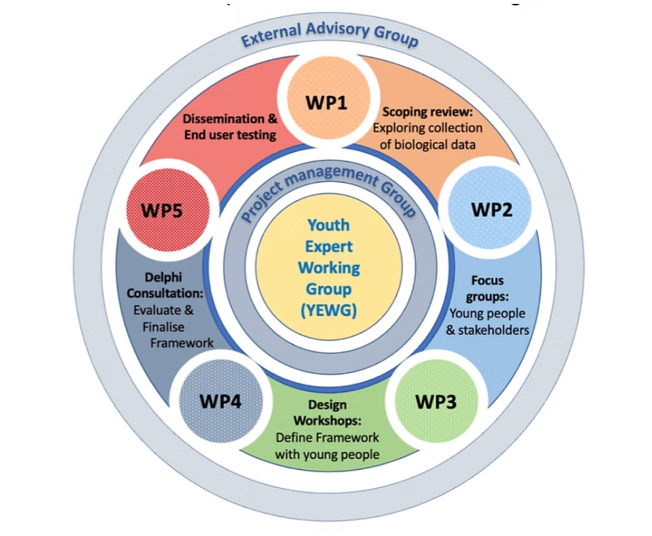
I previously wrote about CELEBRATE’s final dissemination event, From Mission to Framework, held in May 2025, where we shared our findings, celebrated the project’s milestones and marked the end of two years of work.
Towards the end of that article, I teased that our Work Package 1 review would be published very soon.
Well, I’m very happy to say that the wait is over! Our review has now been published in the Journal of Child Psychology and Psychiatry, and I’m here to take you through what we found.
Why Did We Conduct This Review?
Adolescence – the period between the ages of 10 and 19 – is a time of significant social, psychological and biological change. It is also a particularly important period for mental health, with many mental health difficulties first emerging during adolescence and early adulthood.
Understanding why these difficulties develop means looking at how biological, psychological and environmental factors interact during this important stage of development. Doing so could help us better understand risk and, ultimately, improve prevention and treatment.
However, much of what we know about the biology of mental health comes from adults. Research involving adolescents remains more limited and may not always represent the diversity of the wider population, particularly in terms of ethnicity and socioeconomic background.
Part of the issue is that recruiting and retaining diverse groups of young people can be challenging. Recruitment refers to how researchers identify and enrol young people into a study, while retention refers to whether participants remain involved and complete the relevant parts of the research. Barriers can range from stigma and distrust in research to the time commitment involved and discomfort with biological procedures (such as brain imaging or blood samples, for example).
Another important part of the picture is engagement. In this context, engagement goes beyond simply taking part in a study. Researchers may work with young people, families, communities or other stakeholders – including people who are not themselves research participants – to help shape how research is designed and carried out. For example, they might ask young people to review recruitment materials, advise on how procedures could be made more comfortable or accessible, or provide feedback on their experience of taking part.
We therefore looked at recruitment, retention and engagement as potential sources of information about barriers and facilitators. The existing literature does not necessarily describe these factors explicitly as “barriers” or “facilitators”, so we wanted to understand what we could learn from how previous studies recruited, retained and engaged young people
How Did We Do This?
We conducted a scoping review, which is a type of research review used to map the extent, range, and nature of available literature on a broad or emerging topic. Rather than answering one very narrow question, a scoping review helps researchers understand what has been studied, how research has been conducted and where important gaps in knowledge remain.
We systematically searched eight research databases for studies that brought together three key elements: young people aged 11-18, mental health, and the collection of biological data, including brain imaging and biological samples such as blood or saliva.
We deliberately kept our criteria broad, including different study designs and research from across the world. Studies could also include younger or older participants, as long as adolescents aged 11-18 were represented.
To keep the review up to date, we repeated our search twice: first searching in February 2023, then updating it in October 2024 and again in October 2025, to catch papers which had been published since our first search
.
What Did We Find?
We ultimately included 962 papers.
More than half of these studies had been published since 2020, showing that this is a growing area of research. However, most studies came from high-income countries, with relatively few conducted in low- and lower-middle-income countries. Smaller studies were also common, with just over half including fewer than 100 participants.
The studies collected a wide range of biological data, but neuroimaging – methods used to study the structure or activity of the brain – was particularly common. More specifically, blood samples, functional magnetic resonance imaging (fMRI) and magnetic resonance imaging (MRI) were among the most frequently reported methods, while other approaches, such as saliva samples and electroencephalography (EEG), which measures electrical activity in the brain, were used less often.

Of the 962 papers, 892 provided information on recruitment, retention and/or engagement and were therefore included in our more detailed analysis of these areas. By examining what studies reported about each of these stages, we hoped to identify clues about what might make biological research easier or harder for young people to take part in.
When looking at how young people were recruited, we found that the most common route was through clinics and other healthcare settings, followed by schools or population-based recruitment. Some studies used several recruitment methods, often combining these approaches with advertisements or posts.
When it came to engagement, however, reporting was much more limited. Only 8.6% of papers described strategies for engaging young people, stakeholders or communities, or for collecting and providing feedback. Where studies attempted to engage young people, approaches included making procedures more youth-friendly, adapting materials, involving young people in the design of recruitment materials and using mock scanners to familiarise them with neuroimaging procedures. Crucially, among the 43 studies that reported engaging young people, 32 did not evaluate whether these approaches actually worked. Among those that did, the level of evaluation varied considerably.
We found a similar lack of detail when looking at retention, whether young people remained in a study and were able to complete the research procedures. Fewer than half of the papers reported this information. When studies did explain why data were missing, the reasons were often linked to the biological procedures themselves. For example, some young people were unable to complete brain scans, moved too much during scanning, or provided samples that could not be used.
What Does This Mean?
Our review revealed a clear problem: although lots of biological mental health research with young people is taking place, we often know very little about how young people are recruited, whether they remain involved, and how young people and other stakeholders are engaged.
This limited reporting makes it difficult to understand which barriers and facilitators actually influence the successful collection of representative biological data. It also leaves an important question unanswered: are potentially useful strategies not being used, or are researchers simply not reporting them?
There were some promising approaches. Using multiple recruitment and retention methods, keeping in contact with participants, adapting research around young people’s schedules, and involving young people and other stakeholders in the research process may all help. However, these approaches were not consistently reported or evaluated, meaning we still have limited evidence about what actually works.
Our findings therefore point to a clear need for better and more consistent reporting. Researchers need to be transparent about who takes part, how young people are recruited and retained, and how young people and other stakeholders are involved. This would allow researchers to learn from one another and help build biological mental health research that better represents the young people it aims to understand.

So, Where Does This Leave Us?
This review marked the first step in the CELEBRATE journey, providing an evidence base that helped shape the work that followed.
What’s next? We have now submitted our final CELEBRATE framework paper, bringing together the work from across the project into practical guidance for researchers working with young people.
Hopefully, it won’t be long before I’m back with one final CELEBRATE update.


