


The iDoctor Revolution: Could Your Smartphone Replace Your Therapist?

I spent a year at Harvard Medical School’s Division of Digital Psychiatry, working alongside clinicians and researchers to effectively and safely incorporate digital tools into standard human care. I am now studying a Masters at UCL with the Anna Freud Centre in Developmental Psychology and Clinical Practice, continuing my collaboration with Harvard and my research interest in digital health. Here’s the digital-versus-human debate as I’ve lived it - and where I think it’s most likely to head.
What is the iDoctor Revolution?
The COVID-19 pandemic didn’t just spread loneliness and hopelessness - it pushed the already-stretched mental health services past breaking point. Mental health disorders rose by 25% in the pandemic’s first year alone.
Traditional, in-person care couldn’t keep up. So, healthcare systems turned to digital interventions delivered through a patient’s phone.

85% of NHS trusts in England now offer digital mental health interventions to adult patients. That doesn’t mean that in-person therapy has disappeared - but many patients might meet a digital solution before a human one, depending on symptom severity and local clinician availability.
Sometimes digital tools act as a bridge: while someone waits for in-person care, they self-help using asynchronous tools that don’t need a human in real time. Other times, they take over the full treatment. This shift is reshaping care - and digital tools can offer things humans cannot, such as continuous real-time data on sleep and psychological state, or virtual reality environments for exposure therapy.
Widespread debate has followed: could the clinician, not just the patient, become a screen icon too?
That’s the ‘iDoctor revolution’ - the idea that digital tools could fully replace clinical tasks done by a human therapist. Whether that will actually happen, and to what extent, is hard to predict.
Is the iDoctor Revolution Happening?
There’s some evidence pointing that way. In a US study, Artificial Intelligence (AI) systems out-diagnosed human doctors, meaning that they correctly diagnosed patients more frequently than human doctors (67% compared to 50%). In the UK, 30% of over 1000 GPs surveyed in 2024 said they use AI for diagnosis - suggesting digital tools are creeping beyond admin usage and into clinical reasoning. Globally, half of psychiatrists surveyed predicted AI would substantially change their jobs, and nearly 1 in 5 believed it could totally replace a human clinician in providing empathetic care.
But the media narrative of a robot takeover doesn’t hold up against the wider evidence. Today’s tools are still being trained, are poorly regulated, and often built without medical texts as their foundation - making a complete handover far too risky right now. NICE guidelines refer to ‘digitally enabled interventions’ - no digital intervention should be implemented without human oversight. They also recognise room for guided self-help, including apps, especially with milder symptoms.
So, What Could This Integration Look Like?
A full takeover is unlikely, given ethical concerns and lack of safety standards: the more realistic path is a symbiotic relationship between human clinicians and digital tools - one that captures the benefits of digital integration and protects access to quality care, while protecting the human core of psychotherapy.
Indeed, an AI takeover isn’t the only possibility worth talking about. Take digital phenotyping - using smartphone sensors to passively track behaviour and environment as they happen, building a picture of someone’s day-to-day mental health. Unlike self-guided apps (which see low engagement) or AI (which carries ethical risk), digital phenotyping can enrich a clinician’s understanding without replacing their clinical judgement. This seems a more likely alternative, already being trialled in clinical studies.
The Eight Pillars of Good Integration
Digital-human models of care should be guided by the following eight pillars, to ensure efficacy and safety of care:
● Accessible and equitable - reaching people traditional care can’t, fairly
● Patient-centred and personalisable - built around the individual, not just the norm, and modifiable depending on preferences and values
● Evidence-based and safe - properly tested, with real-world controls
● Better care and less burden - for patients and clinicians alike

1 & 2. Accessible and Equitable
Digital tools scale traditional care far beyond what’s normally possible - anyone with a smartphone can reach it, cutting through barriers such as cost, stigma and logistics, which otherwise widen the mental health divide. That matters more than ever now that smartphone ownership is the norm even in disadvantaged areas.
This is already showing up in policy: the NHS’s principles for digital mental healthcare state that access to digital technology should be delivered equitably to all. A patient could be anywhere in the world and still reach both human support (via telehealth; Figure 3) and digital tools - and the latest evidence backs this hybrid approach as a genuine boost to access.

3 & 4. Patient-Centred and Personalisable
This is where the ‘digital navigator’ comes in - a human coach who personalises digital interventions to meet individual needs and values (see Figure 4). Digital navigators boost engagement with both the digital and human therapy, as they are in touch with the patient throughout the week, outside clinical hours with a therapist – something self-help apps can’t replicate.

5 & 6. Evidence-Based and Safe
Any integrated digital tool should be evaluated using the following:
Coproduction - involving people with lived experience at every stage, from design to evaluation
A proper comparison - testing the hybrid model against traditional care, not in isolation
Honest safety reporting - recording adverse events and offering appropriate support to participants
There are still limitations to reckon with, particularly around integrated AI chatbots: limited memory, algorithmic bias, a lack of genuine empathy, ethical judgement or the ability to read non-verbal cues (Figure 5). So, we need global safety standards - and that’s why a figure like a digital navigator matters, overseeing patients outside of clinical hours.

7 & 8. Better Care, Less Burden
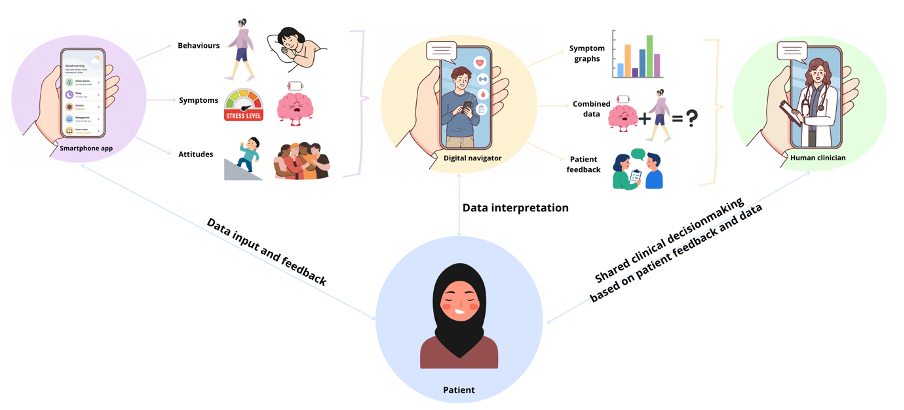
Hybrid models have the potential to boost the effectiveness of traditional care, largely thanks to personalisation. Using digital phenotyping, patients can see their own data - sleep, movement, mood - and clinicians can factor that into clinical decisions alongside what’s discussed in session (Figure 6). Digital navigators also help to cut attrition and dropout by offering consistent support.
The NHS calls this ‘releasing time to care’: digital tools take on time-consuming tasks which eat into patient-facing interactions, or tasks impossible to complete in just a one-hour weekly session. Tools can compile data profiles personalised to specific patients to provide the care team with an outlook on the patient’s experience beyond the clinic walls.
Potential Barriers
New developments always bring with them new questions - chief among them, what’s the right dose and balance of human versus digital support in a hybrid model? Integration is broadening what ‘digital health’ means: not just a single tool, but a whole care-delivery platform, which should be evaluated using appropriate methodologies.
Conclusions
Patients have told me that hybrid care didn’t just match - or beat - the outcomes of usual care. It helped in a broader sense too: symptoms, yes, but also quality of life, motivation and social support. In-person therapy felt familiar; the digital layer added something new, something to fill the ‘in-between’.
I don’t think we’re heading for a total iDoctor revolution anytime soon – but human-digital integration has real benefits worth taking seriously, for patients, clinicians and whole systems (Figure 7). And – if implemented safely – it stops being something to fear, and becomes something worth wanting.


