


The Science of Why Art Moves Us

Eric Kandel, Nobel Prize-winning neuroscientist in Reductionism in Art and Brain Science, argues that our brain is not a camera that simply replicates an image. It is a creativity machine that takes incomplete information from the outside world and makes it complete. This means when you stand before a masterpiece, you're not passively observing, you're actively creating meaning. In The Age of Insight, Kandel calls this the beholder's share: a concept rooted in art history and developed by Ernst Kris and Ernst Gombrich- the viewer's role in completing the artistic experience. Your emotions, memories, and personal history become part of how you see the work. And when you understand the story behind that painting, you activate deeper layers of empathy and connection in your brain. This is where art and science converge, revealing that great art isn't just beautiful, it shapes how we think and feel.
In a recent King's College London study -The Physiological Impact of Viewing Original Artworks vs. Reprints: A Comparative Study, participants who viewed original masterpieces by Van Gogh, Manet, Toulouse-Lautrec, and Gauguin at London's Courtauld Gallery showed significant reductions in cortisol and inflammatory markers compared with those viewing reproductions. Researchers also observed changes in heart-rate variability, suggesting a physiological state associated with both emotional engagement and stress regulation.
These findings suggest that engaging with art is not merely an intellectual or emotional experience. It can trigger biological processes linked to wellbeing, resilience, and reduced physiological stress. Far from being a luxury, art may represent a unique meeting point between culture, neuroscience, and health.
A 2025 study-The impact of viewing art on well-being-a systematic review of the evidence base and suggested mechanisms by Trupp and colleagues, analysed 38 studies involving over 6,800 people across museums, hospitals, and galleries worldwide. Their analysis identified five key mechanisms through which viewing art may support well-being: emotional response, cognitive engagement, social connection, personal transformation, and resilience. Science is showing what artists, philosophers, and dreamers have sensed for centuries: great art can profoundly influence both the mind and the body.
But what if the experience could go even deeper?
Imagine standing before a masterpiece that has captivated people for hundreds of years. You admire its colours, its composition, its beauty. Now imagine knowing the secrets behind its creation, the struggles of its artist, and the journey that brought it to the present day. Suddenly, you are no longer just looking at a painting. You are stepping into a story; you become more than a spectator. You become part of a neuroscience experience.
This is an invitation to do exactly that; we will explore four masterpieces. When you encounter these, whether in person or from afar, you may find yourself experiencing them differently. Not simply as works of art, but as living conversations across time.
If you’ve ever paused, struck by something, a work of art, a discovery, or an idea, then you already understand what drives me. As an artist and psychologist, I am here to bridge those moments of awe with the science behind why they move us. Let’s dive into how knowing the story behind art amplifies that connection.
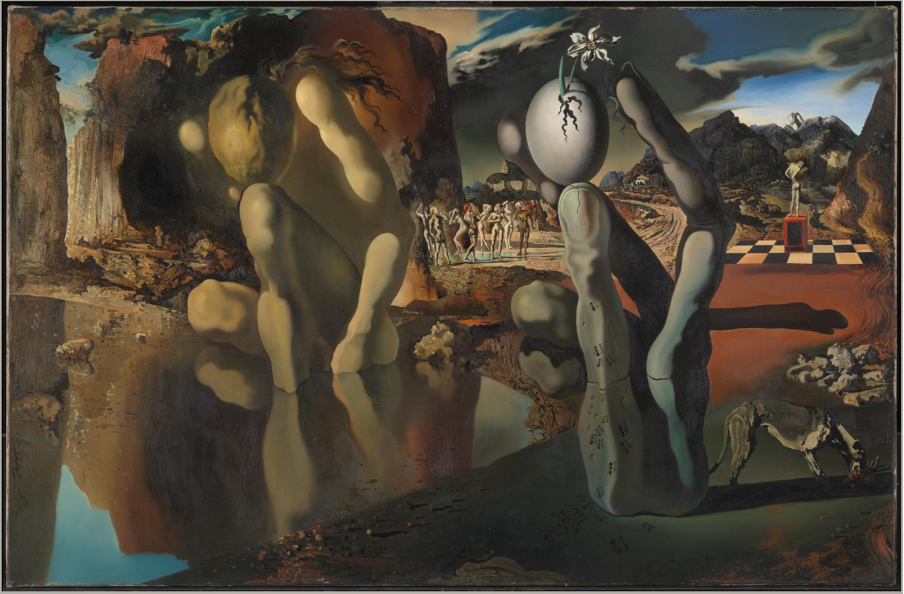
In The Metamorphosis of Narcissus (1937), Salvador Dalí creates an optical puzzle that seems almost alive. At first, you see Narcissus gazing at his reflection. Then, suddenly, the figure dissolves into a hand holding an egg from which a flower emerges. Your mind shifts back and forth between the two images, unable to settle on just one reality.
Dalí painted the work during a turbulent period in his life, while becoming increasingly fascinated by the ideas of Sigmund Freud, whom he would meet the following year in London. The ancient myth of Narcissus, a young man so captivated by his own reflection that he is transformed into a flower, became, in Dalí's hands, a meditation on obsession, identity, and transformation.
What makes the painting extraordinary is that the metamorphosis does not occur only on the canvas. It occurs inside the viewer's mind. As perception shifts and meaning unfolds, you become an active participant in the artwork itself. Standing before the painting at the Tate Modern in London, you are not simply observing a transformation; you are experiencing one.

Sandro Botticelli's The Birth of Venus, painted around 1484-1485 and housed in the Uffizi Gallery in Florence, is one of the most iconic images in Western art. It depicts the goddess Venus arriving at the shore on a shell, fully grown from the sea, carried by the winds, while a figure on the shore reaches out to clothe her.
But the story behind it is what makes it extraordinary. Botticelli painted it for the powerful Medici family during the height of the Florentine Renaissance, a moment when beauty and classical mythology were being celebrated as almost divine. Yet years later, Botticelli fell under the spell of the radical preacher Savonarola, who condemned beauty and art as sinful. Botticelli was so tormented that he allegedly threw some of his own paintings into Savonarola's infamous Bonfire of the Vanities. A man who created perhaps the most iconic image of beauty in history later questioned whether beauty itself was a sin.
That tension, between celebrating beauty and fearing it, adds a profound emotional layer when you stand before that painting. And that emotional layer is exactly what activates the deeper neural mechanisms Kandel and the science describe.

Frida Kahlo's The Two Fridas, painted in 1939 and housed at Museo de Arte Moderno in Mexico City, is one of the largest and most emotionally devastating self-portraits ever created. Frida Kahlo sits beside another version of herself, their hearts exposed, connected by a single artery. One is the Frida that her husband, Diego Rivera, loved. The other is the Frida left behind after his betrayal.
What makes this painting extraordinary is that it is not only about heartbreak. It is about survival. Frida created it while enduring the emotional devastation of her divorce from Diego Rivera that same year, a wound as raw and physical as any she had suffered, including the devastating bus accident that had shattered her body fourteen years before. Standing before the painting at the museum, you are witnessing something rare: a person turning grief into beauty, vulnerability into strength, and a broken heart into one of the most unforgettable images in art history.

Created just a few months after Marilyn Monroe's death in 1962, Warhol's Marilyn Diptych transforms a simple publicity photograph into something almost immortal. Repeating her face fifty times, he captures the strange tension between fame and fragility. Marilyn becomes more than a Hollywood star; she becomes a modern icon.
What first appears to be a celebration slowly reveals itself as a meditation on memory, loss, and the desire to preserve what inevitably fades. Standing before the work, now housed at Tate Modern in London, you are not simply looking at Marilyn Monroe. You are witnessing the moment an image became a legend.
Art is far more than something we simply look at. As neuroscience increasingly reveals, it is an experience that engages our minds, bodies, memories, and emotions in profound ways.
From Dalí's surrealism to Kahlo's resilience, from Botticelli's celebration of beauty to Warhol's image that became a legend, these masterpieces remind us that art lives not only on the canvas but within the mind of the viewer. Science may explain why art moves us, but it does not diminish the mystery. For every time we stand before a great work of art, we are not simply looking at colours or history, we are becoming part of it.


