


World Bipolar Disorder Day: Van Gogh, Between Light and Storm

Trigger Warning: The following content contains discussions about suicide, self-harm, and mental health struggles, which readers may find distressing.
Today, on World Bipolar Disorder Day, we celebrate not only awareness of the condition, but also the birthday and legacy of one of the most brilliant minds in art history: Vincent van Gogh.
Public understanding of mental health has grown significantly in recent decades; however, during Van Gogh’s lifetime, emotional vulnerability was often silenced and left unsupported. Through an analysis of the correspondence between Vincent and his brother Theo, a 2020 study highlighted some of the most critical moments of his journey, revealing periods that appeared to alternate between profound depressive states and intense creative surges.
According to the DSM-5 (a diagnostic manual for mental health disorders), bipolar disorder is defined by the presence of mood episodes that include both manic (or hypomanic) phases and depressive phases. Manic episodes are periods of abnormally elevated mood and energy, while depressive episodes involve prolonged sadness or hopelessness. These mood shifts can impact a person’s ability to function in daily life, and the condition requires careful diagnosis and management. It’s important to understand that bipolar disorder is a complex but manageable condition with the right support and treatment.
This genius, immortalised through his vibrant colours and expressive brushstrokes, endured silent suffering without the medical knowledge or societal support available today. With advances in treatment and growing awareness, bipolar disorder is no longer a solitary fate, but a path that can be met with understanding and care. Today, we honour the artist, the person, and the possibility of a more welcoming and understanding future.
Before we start to honour his legacy, I would like to introduce myself. I’m a psychologist currently doing my master’s at King’s College, and I’m also a visual artist at heart. For most of my life, I’ve woven together the worlds of art and psychology, and Van Gogh’s life has always been a source of fascination for me both as a psychologist and as an artist. And now, being here today, celebrating this occasion and sharing his story feels incredibly meaningful to me. I spent a truly special and almost magical bit of time exploring The Museum about Vincent Van Gogh in Amsterdam, where they’ve curated this beautiful collection of his life story, and I’ve put together a little summary of some of the most meaningful moments to share with you all.

On 30 March 1853, in the quiet Dutch village of Zundert, Vincent van Gogh was born into a world that would one day struggle to understand him. Sensitive from childhood, deeply attached to nature, and introspective beyond his years, Vincent’s inner world was already intense long before he ever held a paintbrush as an artist.
His early life was marked by restlessness. He moved from school to school, from art dealer to teacher, from bookseller to lay preacher. Nothing seemed to settle him. His letters, particularly those written to his younger brother Theo, reveal a young man oscillating between spiritual fervour and profound self-doubt. He longed for purpose with almost feverish intensity yet repeatedly felt he had failed to find it. At 27, he made a decision that would redefine art history: he would become an artist.
What followed was not a steady ascent, but a life lived in extremes.
In the Netherlands, Vincent immersed himself obsessively in drawing and painting rural life. He worked relentlessly, often at the cost of his physical and emotional stability. Letters from this period reveal determination bordering on compulsion, sleepless dedication, rigid focus, and grand hopes that art would redeem both himself and humanity.
Then came Paris.
Exposure to Impressionism and Japanese prints ignited something electric within him. His palette exploded into colour. His brushstrokes grew bolder and more urgent. His correspondence suggests exhilaration, creative acceleration, and heightened ambition. The darkness of The Potato Eaters gave way to luminous fields, cafés, and skies.

But light was always shadowed.
By the time he moved to Arles in 1888, his creative energy surged almost uncontrollably. He painted with extraordinary speed, sometimes completing works in a single sitting. He envisioned building a community of artists, the “Studio of the South.” His letters pulse with excitement, ideas, and momentum.
Yet this intensity came at a cost.
Tensions with Paul Gauguin escalated. Emotional volatility deepened. In December 1888, after days of agitation, Vincent cut off part of his ear. Hospitalised in Arles, his condition frightened even those closest to him. His brother described symptoms of what doctors at the time called “madness.”

Today, modern psychiatric scholars who analysed the correspondence between Vincent and Theo suggest that these alternating periods, profound despair followed by bursts of productivity, agitation, and expansive creative drive, are consistent with features of bipolar spectrum disorder. While retrospective diagnoses must always be approached with caution, the pattern of emotional oscillation is striking.
In Saint-Rémy, voluntarily admitted to a psychiatric hospital, Vincent continued to paint, sometimes with astonishing productivity. In one year alone, he produced around 150 works. On better days, he painted orchards and skies. On darker days, confusion and despair returned. At one point, he reportedly ingested his own oil paint during a severe episode.
And yet, in this very period, he created Starry Night.
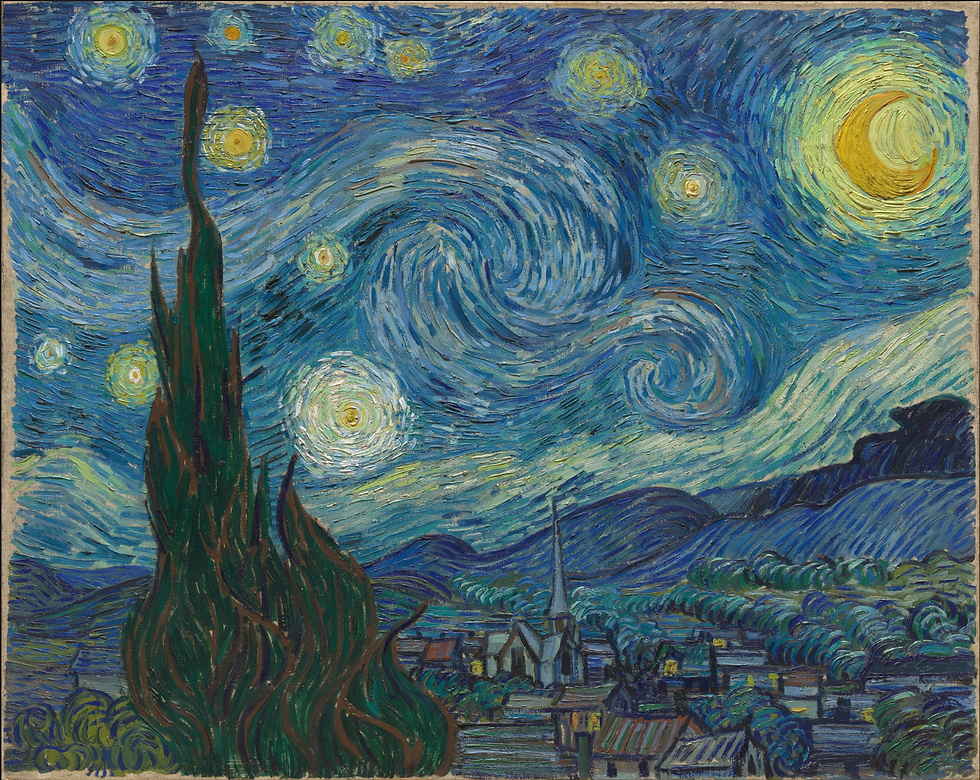
In 1890, after signs that his work was finally gaining recognition, and despite brief moments of renewed hope, financial anxiety and fear of relapse weighed heavily on him. In July of that year, overwhelmed by illness and uncertainty, Vincent shot himself in a wheatfield in Auvers-sur-Oise. He died two days later, aged 37.
He left behind more than 850 paintings. He used to visit the National Gallery in London and could never have imagined that one of his most important masterpieces would one day be displayed there. Today, people from all over the world come especially to see it.
He did not live to see the magnitude of his impact.

To finish up this special journey of this great artist, I’d like to share that my love for Van Gogh’s art and legacy once took me all the way to Saint-Rémy-de-Provence, where he painted some of his greatest works during his time in the facility. So, if you ever find yourself in the south of France, especially in spring or summer, step into those landscapes that shaped his masterpieces. I promise you, you’ll see them come alive. It’s a journey you won’t forget.
Vincent van Gogh’s life was not a romantic tale of the “tortured artist.” It was the story of a man living in a time when mental illness was misunderstood, untreated, and often feared. There were no mood stabilisers. No structured psychological therapies. No language to describe what he experienced.
Today, bipolar disorder is recognised as a treatable condition. With appropriate care, medication, psychotherapy, and social support, individuals can lead fulfilling, creative, and meaningful lives. The very date of his birth, 30 March, now marks World Bipolar Disorder Day, not to define him by illness, but to foster awareness, reduce stigma, and remind us how far mental health care has come.
Vincent’s legacy is not only in his colours, but in what his life teaches us.
Brilliance and vulnerability can coexist. Creativity does not require suffering. And no one should face psychological storms alone.


