The Village We Lost: Parenting, Isolation in a Mobile World

The French Dream, With a Side Order of Loneliness

Close your eyes. Imagine you could live anywhere in the world. Money isn’t a consideration, logistics? No problem. Whatever you fancy is available…
Got it?
Let me guess what you got… a golden sandy beach? Sun rays warming your face? A sangria in one hand with a cabana boy fanning you from the side?
Bingo.
This is what I envisioned when I decided to move to the South of France with my, at the time, 9-month-old bundle of joy (baby, not a puppy, just to clarify). And let’s be honest, maybe not the cabana boy either.
My name is Robyn. I am a 30-something-year-old with a small child who woke up one day and decided it would be a fabulous idea to pack up everything and move my life and family to the South of France.
The result?
Golden beaches – check.
Palm trees – check.
Enough cheese to stink out the entire United Kingdom – check.
But what was missing was something I hadn’t anticipated…
So Where Did Everyone Go? Having a baby is hard, that is no secret. Or maybe it is?
When you scroll Instagram, you’re greeted with images of your friends cradling their cute little babies while everyone is smiling away with glee, having the time of their lives.
Although, often, you see them surrounded by family. So maybe that is the secret sauce?
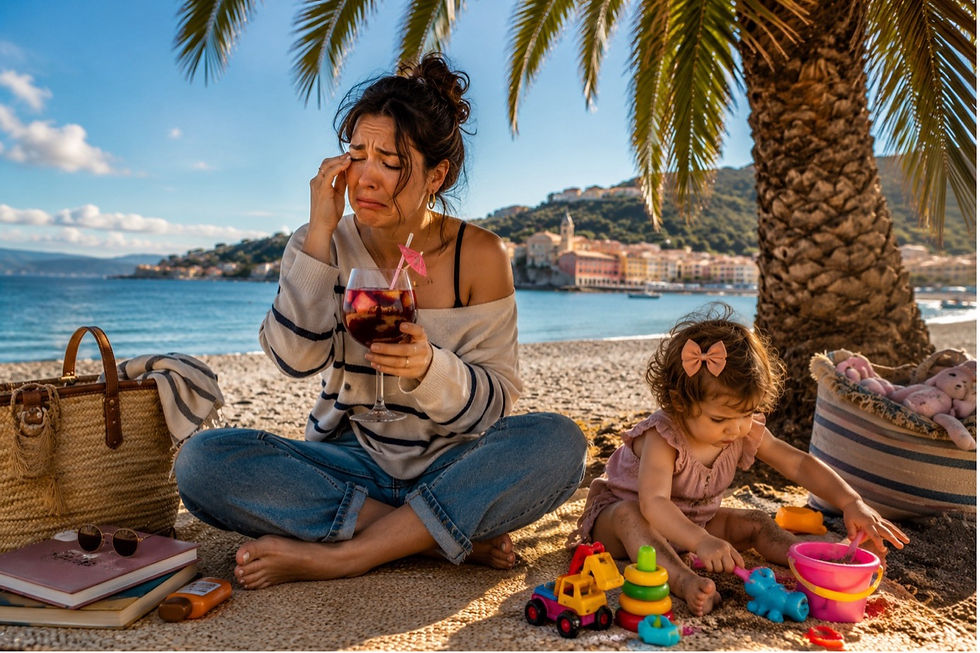
Instead, my pictures were of just the three of us. No Grandma, no Great-Nana. When I found myself crying under a palm tree, slowly watering down my glass of sangria, baby screaming in my arm, there was nobody to help – rien.
It was 24/7, seven days a week, day shifts and night shifts.
And not only that, but the guilt for even having the audacity to think it. How could I be so ungrateful? I love my baby.
But this wasn’t all just in my head. Research has found that when women experience a decline in social support after having a baby, they are at greater risk of poorer mental health and depression. And what’s more, the statistics don’t exactly make for cheerful reading either, with research showing that rates of postnatal depression increased during the years around the Covid-19 pandemic. Maybe support isn’t just a nice extra. Maybe it’s a necessity.
The Village Wasn't on WhatsApp
The year is 2026. Technology has boomed. You can now speak to someone across the globe and feel like they’re right there in your room (with the nice advantage that if they become too annoying, you can suddenly have a ‘connection problem’). And as nice as it is being able to see my family at the click of a button, it doesn’t make up for the lonely birthdays, the moments of despair when you just want to take a shower and for someone to watch the baby. Or for a night off from cooking, and cleaning, and tidying toys, and preparing meals, and cleaning up after the cats. And oh, that thing, what’s it called? Self-care or something?
Actually, even a shower or the chance to change the bed sheets would be a complete luxury.

When Loneliness Starts Talking Back
Ending the call, switching off the phone, and the smile you put on for the conversation, that’s when reality sinks in again.
Alone.
Onto the next task, the list of endless tasks that never gets done because, quite frankly, it’s a job for a village. Leaving a sinking feeling of failure day after day as even the housework slips away, the bed remains unchanged and there’s a weird, unknown fishy smell coming from something lurking at the back of the fridge.
And maybe that sounds trivial. But when you’re already exhausted, it’s not really about the bed sheets or the fridge. It’s the feeling that you can’t keep up.
And research backs this up. One study exploring the experiences of postpartum mothers found that women considered practical, or “instrumental”, support essential to their physical and emotional recovery. The researchers also highlighted the importance of social support in helping women cope with the psychological stresses of the postpartum period.
Maybe I wasn’t failing. Maybe I was just trying to do the job of a village on my own.
Our Home Can Move. Our Village Can't.
Moving out of our safe four walls in the UK to a mobile home in the South of France seems like an amazing idea in principle. An adventure. Something most people would only dream of.
But one thing I didn’t consider was the fact that Grandma, Great-Nana and all the other lovely people I call family didn’t exactly fit into the suitcase.
Yes, we somehow managed to squeeze all our possessions into half a transit van and get them transported down to France. Yes, my child has a room full of toys. But the thing we didn’t account for losing was the people we love – the people who should be there to support us when life gets challenging.
We moved our home. We moved our lives. But we couldn’t move our village.
Maybe We Didn't Lose the Village. Maybe We Have to Build It.
Now I’ve probably already ruined your dream, and for that I apologise. But here is the nice bit. Did we lose the initial support we could have done with? Yes, I won’t deny it. But did we get through it, find new chiefs and Indians, as well as learning ways to cope between the three of us? Yes.
Although, it wasn’t always easy. Being in your 30s, you unfortunately can’t just walk up to another woman and say, “Would you like to be my friend?”
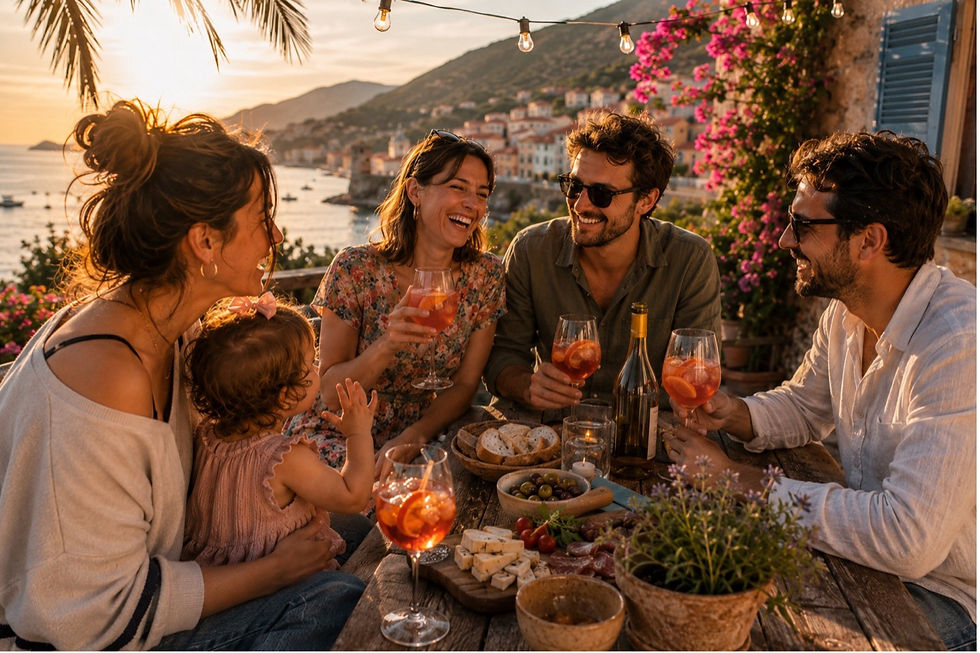
So I’ve had to gradually build friendships over time. But now I have some great people around me who I can enjoy a sangria with under a palm tree without crying all my emotions into it; and that sangria tastes much better.
Whilst I will always miss my native village, this new one will do. And who knows what the future holds?
One thing I have learnt: the village isn’t necessarily something you find. It’s something you build.
This article has been sponsored by the Psychiatry Research Trust, who are dedicated to supporting young scientists in their groundbreaking research efforts within the field of mental health. If you wish to support their work, please consider donating.