


The Men Minds Project: Young men making time for young men

The Importance of Co-Production in Men’s Mental Health Research
Editor’s note: This piece has been adapted from an article published on the UK Research and Innovation (UKRI) website and available here.
My name is Nina, and I am a Senior Research Fellow at the Children and Young People’s Centre for Justice. This year, on the occasion of Men’s Health Week, I wanted to share how co-producing research and working alongside young men can help us understand and address the crisis in men’s mental health, drawing on my experience leading the Men Minds project as Principal Investigator.

When we think about men’s mental health, we often assume that men don’t want to talk about it. This is in part true; in fact, men are far less likely than women to seek help for their mental health, and are, in turn, less likely to be diagnosed with and receive support for common mental health conditions.
However, we should not assume that these patterns mean that men experience fewer mental health challenges. We can’t ignore the fact that young men experience poorer outcomes in relation to some key health and social indicators strongly related to mental health – for example substance misuse, violence, and suicide. The stark reality is that 75% of the suicides among people aged 10 to 44 in the UK are by boys and young men.
These gender-related differences in the mental health statistics are therefore likely to be reflective of reduced knowledge and understanding about men’s mental health, including clinical diagnostic practice, men’s reduced help-seeking behaviours, cultural norms and expectations around masculinities, and stigma associated with mental ill health. Similarly, support services and treatment options often fail to reflect men’s unique challenges and needs. This is not surprising given that men are underrepresented in mental health research, meaning that the evidence used to inform policy, services, and even public opinions might not reflect what men really think and need.
Men Minds wanted to change that by involving young men in designing a research project to better understand men’s mental health.
What is Men Minds?
Men Minds was a research project funded by the UK Research and Innovation (UKRI) as part of the Adolescence, Mental Health and Developing Mind Programme, and it involved a collaboration between the University of Strathclyde, the Mental Health Foundation and Monash University. The aim of this research was to better understand young men’s mental health, and how young
men’s masculine identities interfaced with their mental health, wellbeing, and marginalisation.
Unlike many other studies, the difference of Men Minds was that it was coproduced with a group of young men. Co-producing the research meant that researchers and the young men worked together to design the study in a way that could meaningfully inform policies and services that reflect and respond to their realities.
These young men demonstrated honesty, compassion, hard work and commitment, attending hundreds of hours of sessions over the life of the project and beyond. Many of them still remain engaged today, more than three years since we started, helping to disseminate findings and spread the word about young men’s mental health.
What Did We Do?
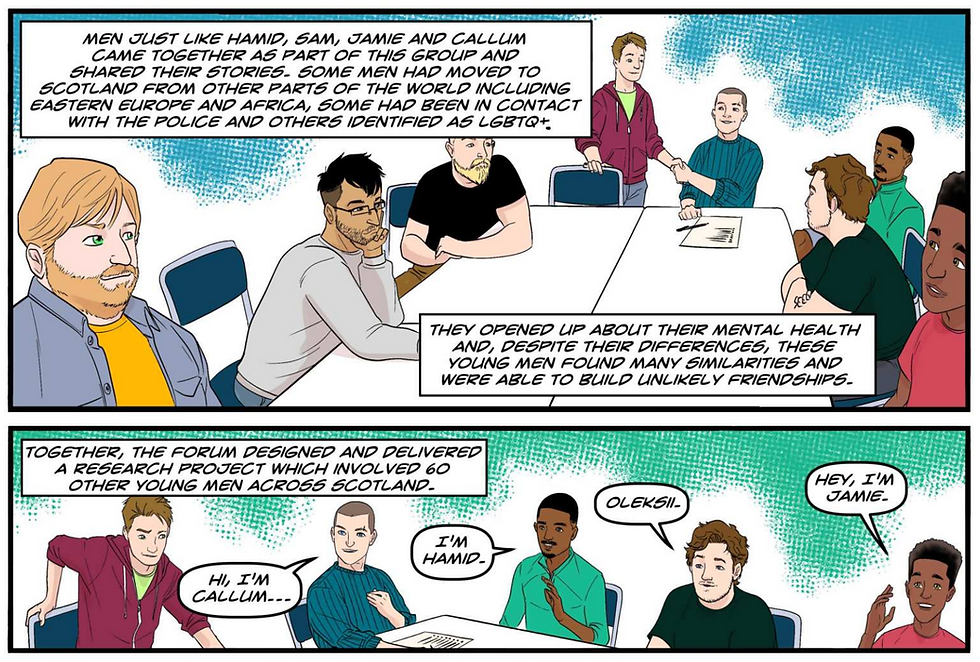
To deliver a co-produced approach, we initially set up a Young People’s Forum (YPF) of 10 young men aged 16 to 24 from marginalised backgrounds, including: refugees and asylum seekers, young men identifying as LGBTQ+, and young men who had been in conflict with the law. The YPF worked alongside the researchers for over two years to guide, design, deliver, and disseminate the project.
We focused on marginalised groups as we know they are more likely to experience additional challenges affecting their mental health and their ability to access support, as well as barriers to participating in mental health research. We felt that by focusing on young men who were more on the margins of society, if we could get things right for them, then we should be able to get it right for young men more generally.
The role of the YPF was to initially help us understand some of the key concepts in men’s mental health – masculinities, wellbeing, help-seeking - from their own perspectives. The YPF then helped to shape and undertake the project; this included exploring and designing relevant and inclusive methods to engage other young men in the research as well as collecting the data.
The young men in the YPF acted as co-researchers carrying out data collection with 60 of their peers across Scotland through interviews, focus groups, and surveys. By drawing on shared experiences and building trust, this peer research approach enabled the study to successfully engage young men from marginalised backgrounds.
What Did We Find?
Masculinities and Misconceptions
We found that many young men no longer believed in the traditional stereotypes of what it means to be a man. They didn’t believe that men had to be strong and stoic, and they knew that men could experience stress, anxiety, depression, and other mental health concerns.
However, although these young men had modern ideas about masculinity, they still felt restricted by traditional social norms and expectations from families, friends, schools, and other institutions. Sometimes these were real restrictions, where young men were told to behave in a certain way, and sometimes these were perceived restrictions in that young men believed they would be judged if they opened up.
They also felt the weight of negative societal attitudes towards young men more generally. As a result, they shared common experiences of shame and stigma, which often left them feeling isolated and alone in their mental health challenges.

Peer Support, Reducing Stigma, and Normalising Conversations
Men Minds highlighted the importance of providing young men with spaces where they are welcomed, and that facilitate a sense of community and connection. Spaces where there is ‘permission’ - but no pressure - to talk about mental health with no judgement.
While Men Minds was not a form of therapy, the young men found therapeutic benefits in taking part, and realised they were not alone in their experiences. One young man said:
“Even if we don't realise it, subconsciously we're learning from each other. So, while you're hopefully helping change the future of people’s thoughts and mental health and that you're also learning how to help yourself more.”
Men Minds highlighted the value of peer support, which emerged in the wonderful, supportive community that the young men in the project created for each other. Who better to support and understand young men than young men themselves?
What’s Next? Passing on the Men Minds Baton
To reassure other young men, help spark conversations about mental health, and reduce stigma Men Minds produced a comic (featured throughout the piece!), based on real-life stories shared in the research. The young men also presented the findings at the Scottish Parliament, to ask MSPs to pay greater policy attention to young men’s mental health.

Informed and inspired by the work of Men Minds, Glasgow City Council have rolled out a year-long programme across all secondary schools. As part of this programme, Young Men’s Minds groups will research the issues affecting boys’ mental health and wellbeing in each schools, and work with staff and other pupils to co-design relevant solutions.
At the launch event, Men Minds participants shared their experiences and advice with the next generation of boys and young men, to encourage them to continue to challenge stereotypes and improve mental health for young men. We can’t wait to see what they achieve!


