The Swimmer — A Short Story

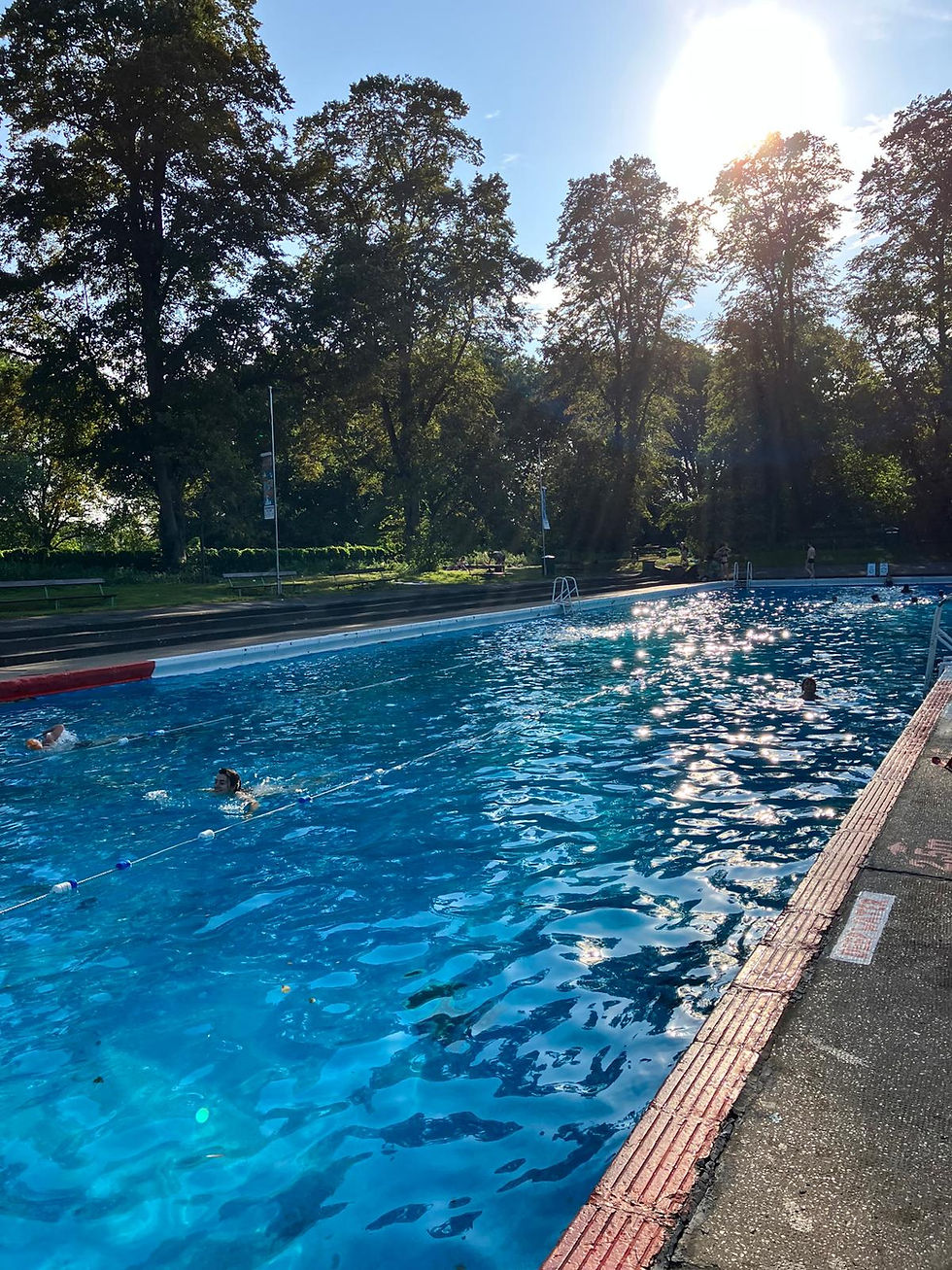
When the swimmer pictures the lido in her mind, the summer sun is always shining, and the water looks blue and inviting. But it’s September now. Brown leaves are curling by the side of the pool, the evening sky is grey and overcast, and the water, when she jumps in, is cold.
She closes her eyes, starts swimming, and waits.
“How are you?” says her mum.
“Fine,” the swimmer replies and opens her eyes. There are trees all around the pool and it is practically empty, just the way she likes it. She breathes in through her nose, out through her mouth, propelling herself forward, thinking about the warmth of her mother’s voice. Her hands. Her touch.
“I miss you,” she says.
“I know,” says her mum.
That’s not right. Her mother would have said: “I miss you too”, of course. But they never really missed each other before. Not like this, not the way she does now.
The swimmer remembers the pool where she learned to swim that summer, all those years ago. Not the pool, so much, but the effort. Lessons every day during the long school holidays. Her determination to complete the course and take home the certificate.
She remembers her mum taking her each morning, rushing to be on time, get changed and get in. Then looking up and seeing her mum in the stands, watching her, her smile blazing. Encouraging her, day after day.
She had thought, at the time, the effort was all hers.
Water has gotten inside her goggles somehow. She tries to blink it away and notices a man doing a splashy front crawl in the adjacent lane. As he passes, she ducks under, slowing her breaststroke and closing her eyes.
She wants to stop.
To cease.
To sink.
“Aren’t you cold?”
At the sound of her mother’s voice, the swimmer forces her eyes open. Presses her hands together flat, turns her fingers into two curves of a heart, pushes them out against the water and joins them together again, thinking of her mother. Making heart after heart – and listening.
“You are, aren’t you?” her mum asks.
“I’m fine,” she says. Ha. Her mum wouldn’t have believed her. Her mum, who grew up by the Mediterranean and loved swimming – but in the sea, in the summer. Not in an unheated lido, in Cambridge, in autumn.
Wind is rustling in the trees by the side of the pool, and there are dark leaves scattered across the surface. The swimmer catches some in her hands but, on her next stroke, releases them. She used to gather them as she swam and deposit them on the side, but she thinks it is pointless, now, to clear a path.
No matter what she does, more leaves will fall.
The swimmer thinks about how cold the branches of the tree will feel then. How bare.
She turns away, onto her back, her hair in the water, and allows some of her favourite memories to float into her mind. On a summer holiday, swimming in the sea with her mother, being treated to a strawberry ice cream afterwards. The sweetness of it in the heat, in the sun.
“That’s right - you used to love those Strawberry splits,” says her mum. “And on the beach, we held hands and jumped with the waves - do you remember?”
“I remember,” the swimmer replies.
The clouds overhead are darkening. She swims another lap of the 100-yard pool, reaches the wall and flips back into a breaststroke, checking her smartwatch on her way. She makes a deal with herself. One kilometre. Eleven laps. That’s her goal.
She moves out in the lane to overtake a wrinkled old lady wearing a bright red bathing cap. She wonders if the woman is in her seventies or eighties.
The swimmer has started noticing it more than she used to, how old the old are.
“I miss you too,” says her mum.
The words disturb and comfort her. She redirects her focus to her breathing. In, out, in, out… It feels like flying sometimes, the kicking, the surging forth through the water. The swimmer particularly likes the moment she reaches the end of the pool and kicks off the wall, catapulting herself into her next lap.
“Wow you’re doing so well,” says her mother. “Keep going.”
Her body is in a really good rhythm now, her arms and legs working in unison, breathing in concert, forcing the water to part, pushing her way through. The swimmer tells her mother about the delicious meal her husband made last night, that funny film they watched, how her daughter Rose is settling in at secondary school. She tells her what Rose said that morning at breakfast, how she made them both laugh. “I miss her so much,” says her mother. “I wish I could see her.”
The swimmer wonders whether she should reply: ‘She’s growing up so fast’. Whether she should tell her mother: ‘She’s not a little girl any more.’ She doesn’t want to.
“You must give her a hug, from me,” her mother says.
“Yes,” she promises, a lump in her throat. Yes, she must.
She swallows - hard - and glances at her watch again. She’s on her final lap. The lifeguard is walking back and forth along the side of the pool, his yellow pack slung across one shoulder. He looks bored.
“I love you,” says her mum, just the way she used to.
She can always hear them, those words, in her mother’s voice. It’s never too cold to hear them. It’s never too hard. She knows that. She hears again those words, audible, in her mother’s voice. And again, and again. She turns her face towards the pool. There’s water in her goggles again, and she doesn’t want anyone to see.
It’s then that the swimmer feels the first one land on her shoulder, then another. She looks up. The whole pool is alive with raindrops. They are hammering, scattering, dancing on the surface. They are falling and bouncing, colliding with each other, the other swimmers and the water. She lifts up her face, feels them land on her forehead, on the tips of her ears, on her exposed skin. Cleansing. Soothing.
She reaches the end of the pool, stands up. Her heart is beating and her muscles are aching. 1.006km. She presses the stop button on her watch, removes her goggles and breathes deeply.
Tears from the sky are still falling onto her face and arms like raindrops. Her cheeks are wet and the air is cold but she knows her towel is waiting for her. That she will wrap herself in it, then peel off her wet swimsuit and treat herself to a boiling hot shower and an even hotter cup of tea. That she will put one foot in front of the other and miss her mother and drink her tea in the rain and miss her mother and cycle home across Jesus Green and miss her mother, and it will rain and it will rain and it will rain and she will do it all in the rain, despite the rain.
And in a few days, she will come back to the lido and tell herself it isn’t too cold, it isn’t too hard, and she will get in and do it all again. And swim her heart out in the whirl of the wind and under another dark sky.
And, when autumn departs and the trees are bare and winter turns the lido into ice, the swimmer will think of her mother and look each day towards the sun, and for the light.
She heaves herself out of the water.
“Well done,” says her mum. “Well done.”
Author's Note: My beloved mother and my best friend, Prof Pnina Werbner, died very suddenly and unexpectedly three years ago. She had always encouraged me to be a writer. I took a creative writing course after she died, to honour her memory, and this is the first short story I ever wrote: the homework for the class was 'write an imaginary conversation with someone you know'. It has never been published before. It was longlisted for the Edinburgh Short Story Prize and the Bournemouth Writing Prize, and came runner-up in two contests, the SaveAs Writers' Creative Writing Awards and the Sunspot Lit Goldilocks Zone award.
This story was inspired by cold water swimming in Jesus Green Lido in Cambridge, which is fundraising for a new community sauna. To donate to the campaign please visit JustGiving.
This article has been sponsored by the Psychiatry Research Trust, who are dedicated to supporting young scientists in their groundbreaking research efforts within the field of mental health. If you wish to support their work, please consider donating.