


How Stoicism Became My Antidote For Anxiety


Growing up, I thought Dad was stoic. He always managed to keep his emotions in check, even when he was diagnosed with Myotonic Muscular Dystrophy, alongside my uncle and aunt. Even as he watched them pass away and felt his own muscles atrophy until he couldn’t leave the house any more, he kept a stiff upper lip like the British men of his generation had been taught to do by their fathers.
When Dad died in 2025, I thought about his stoicism and how I was going to cope with the fact I’d lost him only weeks after I’d welcomed my daughter Freya into the world. The Stoicism I reached for to navigate this difficult period was a different kind to Dad’s keep-stum-and-carry-on attitude.
It’s a kind I’ve returned to throughout my life during times of dealing with bouts of social anxiety that started in my teenage years but didn’t know how to name it. All I knew was the all-consuming, crippling feeling of wondering if I was good enough that eventually made me contemplate taking my own life at the age of 14.
When COVID happened in 2020, those same feelings of being unworthy and trapped returned. I didn’t want to feel like that again, so I started listening to a lot of podcasts and found The Daily Stoic by Ryan Holiday.
This was the moment I found a perspective that helped to address everything I’d been trying to cope with for years. I’m talking about the philosophy of Stoicism. I believe it has truly life-changing effects for creating a positive mental health routine.
What is Stoicism?
There’s a difference between ‘little s’ stoicism and ‘big S’ Stoicism. The former is a character trait, and the latter is a philosophy and way of living that can teach us how to regulate our emotions, while accepting that we can still feel our emotions and talk about them.
The simplified story of Stoicism is that it was started by a bloke called Zeno of Citium in 300 BC. A wealthy merchant, Zeno was shipwrecked in Athens, and he lost everything so he needed to find a way to move forward. He found a bookshop and read a book written by Xenophon, a student of Socrates. Zeno asked the owner of the bookshop how he could learn from people like Socrates.
The bookseller told Zeno to speak to a philosopher called Crates who had just walked past the shop. So, Zeno sat under Crates’ learning tree and developed his philosophy at a place called the Stoa Poikile (painted porch) in the market of Athens.
Here, Zeno created a philosophy built on four principles of courage, wisdom, temperance, and justice. Zeno taught that we can only focus on what is within our control and that a Stoic must live in accordance with nature (which doesn’t mean walking naked through nature by the way). Simply, it means to be in harmony with human nature and to have a responsibility towards our communities. Stoicism isn’t about being passive or emotionless. Zeno created his philosophy to encourage practitioners to take an active interest in the world, whether that be in one-to-one relationships or on a big community scale to create impact.
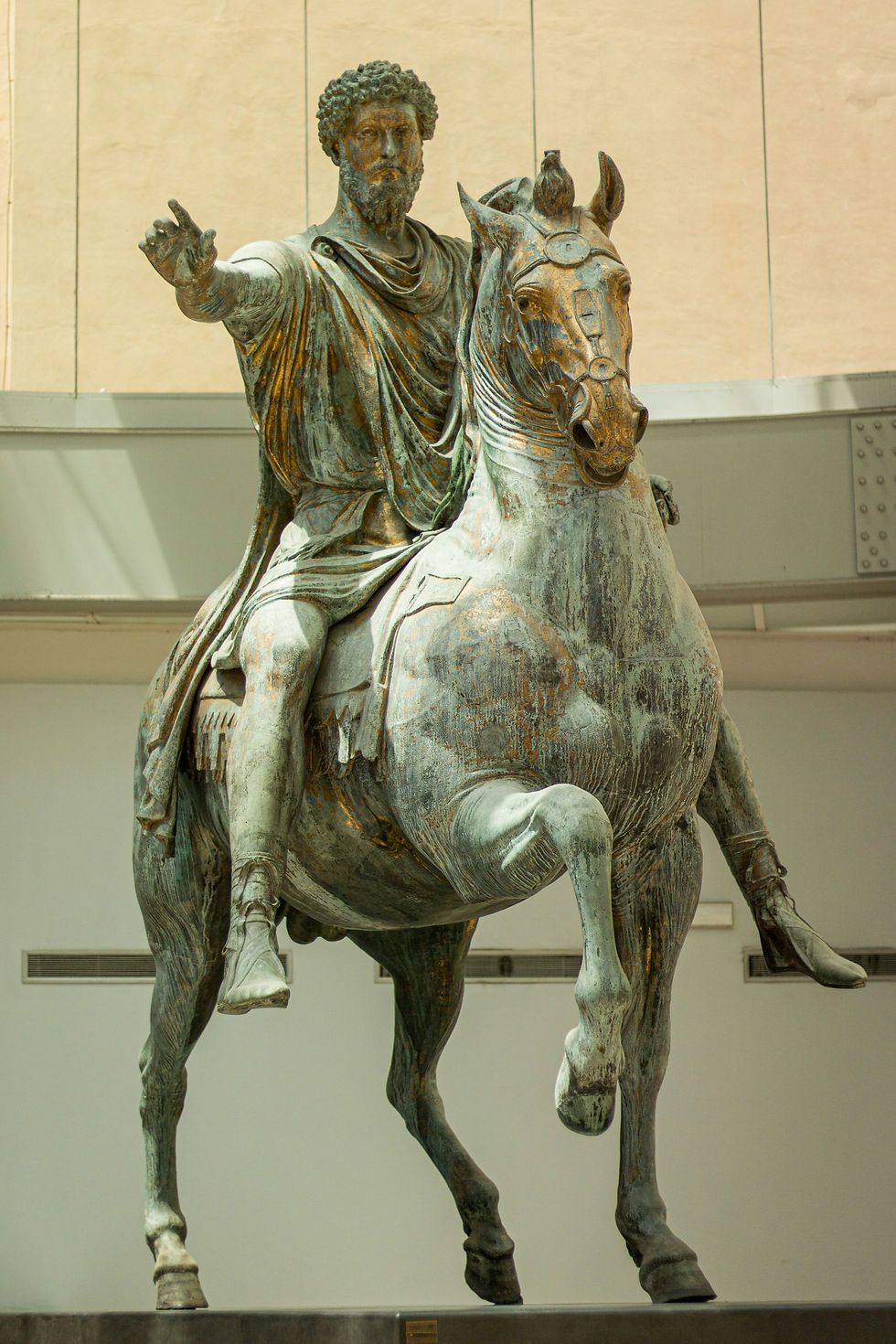
Eventually, Stoicism found its way to Ancient Rome where famous names like the politician Seneca and emperor Marcus Aurelius put it into practice as a way of living. In the modern day, there’s been a renewed interest in Stoicism thanks to authors like Ryan Holiday and his podcast The Daily Stoic.
How Can Stoicism be Applied to Mental Health?
I’ve experienced social anxiety on and off. In big crowds, I’ve felt trapped and paralysed and questioned my self-worth. I’ve struggled in my role as a dad, wondering if I’m doing enough. At times like these, I use a toolbox of Stoic techniques to soothe my nervous system. Here are some of my favourites:
The View From Above
This technique was a popular choice for Marcus Aurelius when he needed to take a big-picture view of a situation. In Meditations, he writes:
“Think of substance in its entirety, of which you have the smallest of shares; and of time in its entirety, of which a brief and momentary span has been assigned to you; and of the works of destiny, and how very small is your part in them.”
What he meant was to consider that there are people all around you experiencing the same anxieties and uncertainties. To see all of this from above by imagining you are looking down at yourself, then your city or town, then at the world as a whole, and realising that what you are experiencing is normal. By the time you’ve done this exercise, you can objectively see that how you react to a situation can be controlled.

The Premeditation of Adversity
Seneca liked using this technique to help inoculate himself against stressful situations. The concept is also called negative visualisation where you mentally rehearse a scenario and consider all of the setbacks that may happen.
I’ll caveat this by saying that this technique may not be for everyone if you feel that imagining the worst-kind-of scenario would aggravate your mental health.
But by the time you experience the situation for real, you may not feel anxious about it any more. If you still stumble, that’s okay. What matters is you were able to visualise different outcomes and attempt to respond to adversity.
Contemplating The Sage
Another Stoic idea is The Sage. This is a figure who’s become a Jedi master of the philosophy and is never ruled by fear, depression, or anxiety. There’s nobody like that in real life and that’s the point. The Sage is an ideal to aim for.
When doing this exercise, I like to think of historical and fictional characters who have traits that I admire and that I can attempt to model. You can do the same by thinking about the traits of someone you admire and considering how you can apply them to your own life.
This may be helpful when it comes to making decisions or taking a step back from a stressful situation.
Using Stoicism in the Right Way
So far, I’ve described Stoicism in its simplest terms. It’s a nuanced philosophy with lots of finer points that are easy to misunderstand without the right context and framing. At times, it may even be co-opted to push dangerous narratives that can damage mental health.
A misconception is that Stoicism is a male-only philosophy. The truth is that Stoicism is a philosophy for everyone because it promotes virtue as the highest good, meaning that practising virtues like justice and wisdom creates a sustainable path to lasting happiness or eudaimonia (human flourishing). Ancient Stoics like Musonius Rufus advocated for women to be able to study philosophy as well.
Unfortunately, a sub-culture of ‘Broicism’ has developed in certain parts of the internet. Influencers have distorted Stoic teachings into a form of toxic masculinity that targets vulnerable young men. Broicism strips away morality to push self-serving narratives of success and fragile alpha maleness. It’s vital to separate these harmful ideas from what Stoicism is as a philosophy so people of all backgrounds are equipped to use it ethically and appropriately for their mental health.
When I think about Dad now, I’m grateful he was there and for the lessons he taught me. They are lessons I hope to pass on to Freya and to help create the space where she can find ideas that work for her exactly like Dad did for me.
Stoicism might be a part of her own toolkit one day. But it doesn’t have to be. What I love most of all about philosophy is that it’s a sandbox to play in where nothing is ever set in stone.
And Freya sure as hell loves sandboxes.
This article has been sponsored by the Psychiatry Research Trust, who are dedicated to supporting young scientists in their groundbreaking research efforts within the field of mental health. If you wish to support their work, please consider donating.


